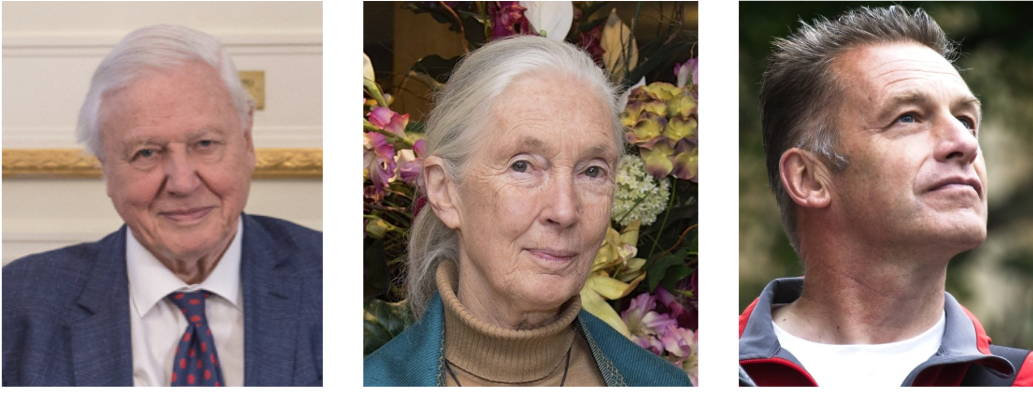
TRIGGER WARNING: This is an article about population, written by a privileged, old white man, focusing on the views of other privileged white people. Please take appropriate precautions.
It was impossible not to be moved by the warmth of the public’s response to David Attenborough’s 100th Birthday. And given his extraordinary achievements as a broadcaster and brilliant science communicator, it all rang so, so true.
With one notable exception.
From the BBC, Sky and all major media outlets, through to the thousands of individual and organisational tributes, there was barely a mention of his tireless work raising awareness about our population and the importance of family planning – most prominently as a Patron of Population Matters since 2009. (Full disclosure: I’m President of Population Matters, so I have a lot of skin in this particular game).
Attenborough’s most succinct summary of the problem (“all our environmental problems become easier to solve with fewer people, and harder – and ultimately impossible – to solve with ever more people”) is still very widely quoted. And his President’s Lecture for the Royal Society of Arts, 15 years ago, remains his most thoughtful contribution to this vexed and controversial debate.
So why the censoring of this part of the Attenborough legacy? Why the ‘population silencing’, to use the telling phrase so eloquently elaborated on by Professor Diana Coole? (How Population Became a Dirty Word ).
I’ve spent much of my life trying to understand why so many environmentalists and human rights campaigners find it so difficult to talk about population. Chris Packham, one of David Attenborough’s Co-Patrons in Population Matters, got right to the point in his recent documentary ‘Greenwashed:
“It’s still one of those things where there’s a real taboo about it. We’ve got one planet, and there is only so much we can take out of the ground, out of the sea, out of the atmosphere. We’ve still got to have this conversation about how many people can the planet support. It’s still controversial at the moment, but unless we have those conversations in public, it will continue to be controversial”.
I obviously couldn’t check out all the responses to David Attenborough’s 100th birthday, but I came across one (in Sussex Bylines) that may explain why most environmentalists and human rights campaigners stay well clear of this taboo territory. It accuses him of a “ neo-Malthusian attitude” that has “contributed to a litany of global injustice, allowing powerful industries and the wealthy to dodge responsibility for their disproportionate impact on the planet, and instead lumping the blame onto the global poor for having too many children”.
Phew! Talk about lèse-majesté.
David Attenborough and Chris Packham are not alone in being defamed in that kind of style. I’ve put up with it for 50 years. But I still come at it from a straightforward human rights perspective, in line with the conclusions of the critically important 1994 International Conference on Population and Development in Cairo, with its focus on reproductive healthcare, family planning and women’s empowerment even calling for a “feminist population policy”– whatever happened to that counter-intuitive terminology?!.
I remain convinced that advocating for the rights of the tens of millions of women in the world today who do not have access to contraception (let alone to any kind of wider reproductive healthcare), while simultaneously highlighting the benefits of there being fewer rather than more people on this planet, are completely compatible.
However, I understand the problems of speaking out. People like me like to think that our motives and values are completely ethical, but it’s still true that the views we express can inevitably end up ‘providing cover’ for those with a much darker agenda, who still talk about ‘population control’, and who feel completely comfortable with the kind of racist, eugenicist arguments that were once commonplace.
At the same time, I hope I’ve also been completely consistent in addressing overconsumption as much as overpopulation. In terms of ‘fewer people on the planet’, my pecking order will always start with fewer billionaires and ultra-wealthy people, especially in the context of the climate crisis. I read recently of some work done by the Global Footprint Network pointing to the fact that “if everyone on the planet emitted carbon like an average top 0.1% US household, we would need 84 Planet Earths to sustain such lifestyles”.
And there’s another problem: David Attenborough, Chris Packham and I are all white, privileged men. This doesn’t (I hope) invalidate what we say, but it’s hardly surprising that it leads some to dismiss such views out of hand. Even white, privileged women come in for the same treatment, as was the case with Jane Goodall — a former patron of Population Matters.
Jane died in October last year, at the age of 91. I looked up to her as an inspiring role model ever since I first became an environmental campaigner in the 1970s.
So, I scoured the outpouring of dozens of beautiful and very moving obituaries that marked her death. I can’t honestly say that I was very surprised by this, but hardly any of them mentioned her life-long interest in population issues. Even her own Institute barely referred to this part of the work; the Wikipedia obituary ticked it off in 10 words. For the rest, zilch.
That is pretty startling. Throughout her life, Jane Goodall cared passionately about making the connections between conservation, education and population. Her ground-breaking research studying chimpanzees in the Gombe National Park in Tanzania (which started in the 1960s) found her having to confront all sorts of human/wildlife conflicts. This is what she wrote in 1990:
“It first hit me, really hit me, when I flew over Gombe National Park in 1990, a tiny island of forest surrounded by completely bare hills, it was obvious that there were more people living there than the land can support.”
My hunch is that some readers here may be feeling somewhat uncomfortable about those words. Is it right for a privileged white woman to be reflecting on the balance between the needs of conservation and the needs of local, black communities in a country like Tanzania?
I am, of course, being deliberately provocative. As we all know, these are complicated matters, and require us all to tread very sensitively. But Jane Goodall herself was clear about how best to engage with them. First, in castigating point-blank those who refuse to engage at all:
“Population is one of the most important issues we face today. We can’t go on like this, we can’t push human population growth under the carpet …..I would encourage every single conservation organisation, every single government organisation, to consider the absurdity of unlimited economic development on a planet with finite natural resources.”
Second, she refused to be cowed by those who accused her head-on of being insensitive to the victims of deeply abhorrent racist beliefs and behaviours since the days of the British Empire in Africa. Nothing could have been further from the truth. Her approach to these issues was imbued with a deep understanding of the lives of those people living near the Gombe National Park, and of the daily pressures they had to cope with:
“If you know enough about poverty and its helplessness, you totally understand why people are cutting down trees, and setting snares for bushmeat”.
That kind of compassion and empathy (starting from the place of loving all humans equally) is what is often lacking in conversations about population and the environment. As is love and reverence for the whole of the non-human world with which we share this planet.
Lastly, although always very soft-spoken and respectful, Jane Goodall had little time for the politically correct evasions of mainstream environmentalists (particularly in organisations like WWF International) who simply refuse to respond to the reality on the ground – with wildlife populations having declined by 75% since 1970 and more than one million species now at risk of extinction. As she said, “it’s irritating to find conservationists not wanting to bring people into the picture.”
I don’t know this for a fact, but I can’t help but imagine that she would have been mightily perplexed by today’s so-called ‘pro-natalism debate’. Over the last decade, we’ve seen the emergence of more and more people angsting that there are going to be too few people in the future rather than too many.
Endless think-tanks and polemicists are out there shouting about ‘the existential risk of population collapse’, intent on persuading people that this is now the greatest long-term threat to the future of humankind (rather than runaway climate change, or collapsing ecosystems, or the renewed threat of nuclear conflagration, or future pandemics or the impact of AI etc etc). They also worry away about the massive short-term threat, as they see it, given that our growth-obsessed economies depend on there being more and more consumers to sell more and more stuff to every year. I would argue that this whole confected ‘fertility crisis’ is driven by our addiction to economic growth and is just dead stupid — as in Jane Goodall’s reflection about natural resources above.
But it would be wrong to dismiss such crass pro-natalism out of hand. It’s true that two thirds of people today live in countries where average fertility is already below the replacement rate of 2.1 children per woman, that average fertility rates are continuing to decline in a significant number of countries. However, the latest projections from the UN’s Population Fund (which has had a pretty good track record on forecasting over the years) is that our population will reach about 10 billion by 2060 (up from 8.2 billion today) before peaking around 2080 at around 10.3 billion.
When Jane Goodall was born in 1934,the population of the world stood at 2.2 billion. That’s more than 6 billion additional human beings in one lifetime. Happily, the rate of population growth has now slowed markedly, with ‘just another 2 billion’ baked in, mostly in countries in Sub-Saharan Africa. Including Tanzania, where average fertility is still 4.5. Current levels of population growth throughout this region are already driving unheard of levels of drought, land degradation and desertification – as powerfully laid out in Population Matters’ recent report, “Dried Up Future”.
As the Intergovernmental Panel on Climate Change continues to point out: “globally, GDP per capita and population growth remain the strongest drivers of greenhouse gas emissions from fossil fuels in the last decade.” And whilst it’s absolutely true that most of those increased emissions are caused by the most well-off consumers living in the most well-off countries, particularly the ever-more profligate billionaire class, we also have to take into account additional pressure on land, on biodiversity, and on often very scarce water resources.
The Jane Goodall Institute is well aware of all this. It continues to do very good work, and weaves family planning, reproductive health care and education about HIV/AIDS into all its projects in East Africa. But it doesn’t exactly shout out about it. Perhaps another, more insidious version of ‘population silencing’?
(If you want see what a truly inspiring, integrated approach looks like in Kenya, check out the latest Impact Report from Chase Africa).
Will this ‘conspiracy of silence’ ever be broken? Unfortunately, I think that’s unlikely. Mainstream conservation and environment organisations are comfortable in their continuing silence and simply don’t want to face the unavoidable controversies involved in seeking to make the connections that Jane Goodall did.
As David Attenborough still does. And will do till his dying day.
Jonathon Porritt 27 May 2026
Image attributions:
David Attenborough: By Bergen Chamber – Own work, CC BY-SA 4.0, https://commons.wikimedia.org/w/index.php?curid=191611973 Jane Goodall: Image from Wikimedia Commons Chris Packham: https://creativecommons.org/licenses/by/2.0


