27/1/2026 Updated 18/2/2026
I first posted this blog just before the re-trial of the six health workers accused of criminal damage for cracking the windows of J.P. Morgan back in 2022. I had to take that blog down, for fear of causing umbrage to the trial judge, but can now repost with the UTTERLY JOYFUL ADDENDUM that they were all found NOT GUILTY on Monday this week!!
And should you like to dig down a bit into the details, here is the link to the press release from Health 4 XR, together with three brilliant closing speeches.
It’s more than seven years since Extinction Rebellion staged its first major happening in November 2018, blockading five London bridges, demanding the politicians start telling “the whole truth” about the Climate Emergency, and jolting back to life the UK’s then moribund climate movement. After four tumultuous (and surprisingly successful years), XR gave up on its disruptive, direct action campaigns — to be succeeded by Insulate Britain for a few short months, and then by Just Stop Oil. After an equally tumultuous three years, it too followed in XR’s footsteps by “hanging up the high vis”.
These days, we don’t hear much, if anything, about the Climate Emergency. It’s been largely ‘disappeared’– despite all the evidence that the Climate Emergency goes on getting inexorably worse month after month.
Which must feel very disturbing for all those still contemplating trials for the actions they took during that time. Just Stop Oil tells me that there are more than 50 trials scheduled for 2026 – almost one a week.
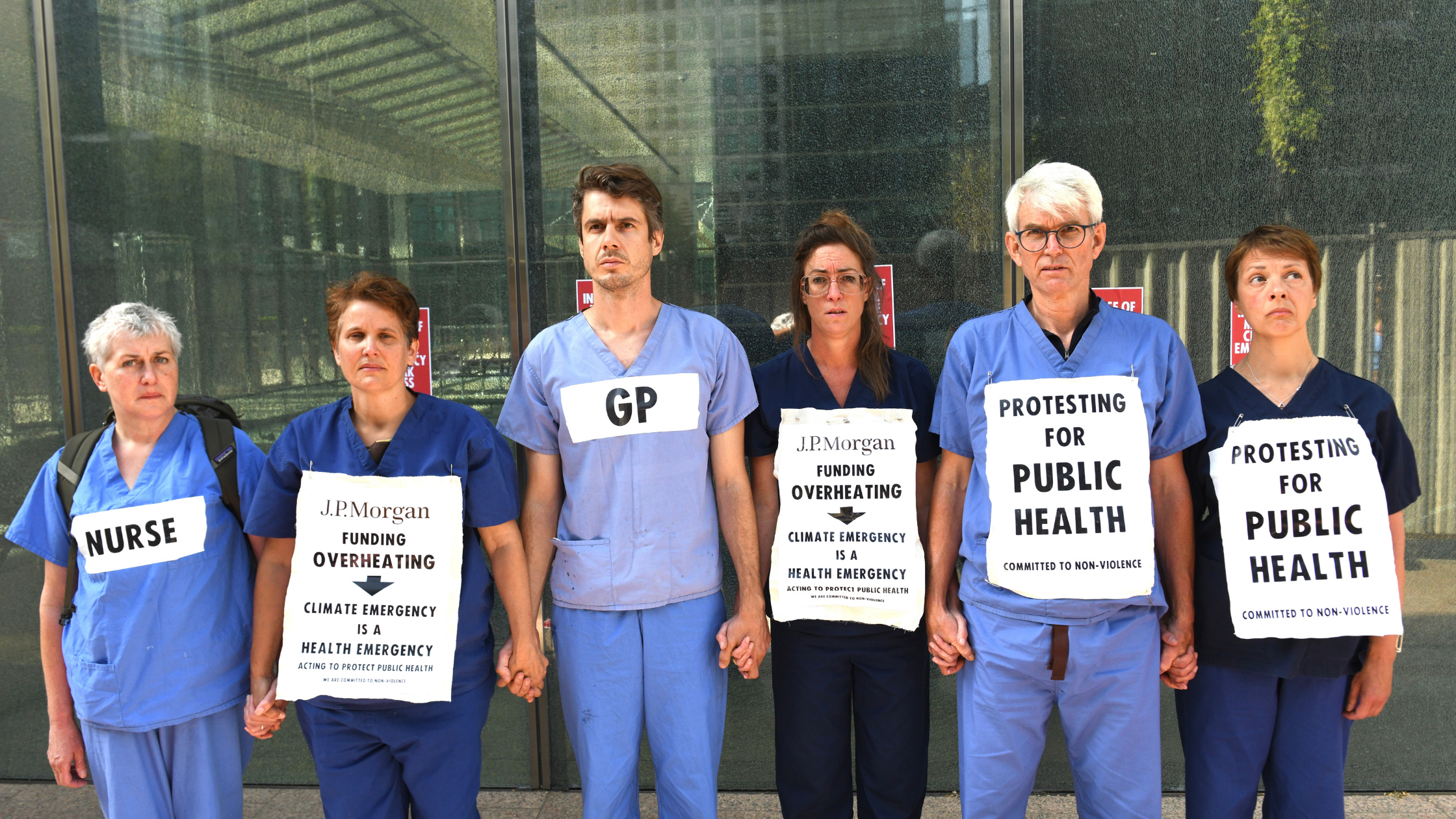
One of those – a re-trial, as it happens – starts on February 2nd in Snaresbrook Crown Court. Back in July 2022 (coinciding with the 40°C heatwave in London), 6 medical professionals turned up outside the London HQ of JP Morgan and applied their hammers to eight of its big windows, causing, by all accounts, £192,000 of damage. Charged subsequently with criminal damage, their trial took place two years later in Snaresbrook Crown Court — but after a couple of weeks, the jury was unable to come to a majority verdict. Hence the re-trial.
On Thursday last week (courtesy of Chatham House’s Sustainability Accelerator), I was lucky enough to go to a play at the South Bank Centre (‘In Case of Emergency’) based on the transcripts from the trial. It was an extraordinary experience, moving, enlightening and more than a little depressing all at the same time.
A lot of the play’s dramatic intensity rested on the increasingly convincing case that today’s Climate Emergency is, in the first instance, a Medical Emergency, with multiple and worsening health impacts associated with rising temperatures and climate disasters all around the world. Which (I suspect!) is what caused dissenting members of the jury to find it impossible to find the defendants guilty — with an ever-worsening health burden giving them a powerful “lawful excuse” for the damage done to J.P. Morgan’s HQ.
(By the way, for avoidance of doubt, J.P. Morgan is the world’s worst offender when it comes to financing the Climate Emergency – to the tune of nearly $500 billion of new investments in fossil fuels since the Paris Agreement in 2015).
So much has changed since July 2022, and I’ve no doubt the defendants’ lawyers will be keen to stress two hugely important developments since the first trial:
- Heat Related Deaths
The World Health Organisation calculates that there are already around 500,000 heat-related deaths every year, and the numbers are rising all the time. Not just in hotter countries: Europe’s very hot summer in 2025 drove an estimated 16,500 additional deaths.
2. The International Court of Justice
In July 2025, the ICJ in The Hague delivered its ground-breaking judgement “on the obligation of states with respect to climate change”, determining that the 1.5°C temperature target in the Paris Agreement is legally binding, and that all states (particularly the biggest emitters) must take ambitious mitigation measures in line with the best available scientific evidence to “prevent foreseeable climate harm” (While the ICJ’s ruling is not itself legally binding, it carries huge political and legal weight).
As I was sitting there listening to the defendants’ testimony in ‘In Case of Emergency’, my brain kept churning all the different ways in which the world has changed since July 2022. I tried to capture this, the morning after, in four dramatically divergent timelines:
- THE REAL WORLD
No need to sugarcoat this: emissions of greenhouse gases up every year; concentrations of CO2 and Methane up every year; average temperature increases is nudging up every year, with ocean temperature increases through the roof; climate-induced disasters, inflicting ever-greater economic costs, worsening throughout that time; and scientists increasingly concerned about the vulnerability of critical “tipping points”– in the Antarctic and Arctic, for instance, or with the world’s rainforests and coral reefs.
2. POLITICS AND MEDIA
The situation today is so much worse than back in 2022 – and not just because of Trump. Tragically, the UK’s cross-party consensus on the Climate Emergency that underpinned the groundbreaking Climate Change Act back in 2008 has disappeared. Both the Tories and Reform are now in full-on ‘emergency, what emergency?’ Mode – so, screw Net Zero and just let things rip.
And as for the media, the latest analysis from Carbon Brief revealed that in 2025 (for the first time ever) editorials opposed to climate action overtook those in support of climate action in the mainstream print media, particularly in the Sun, Daily Mail, Telegraph, Daily Express and Times.
3. THE LEGAL WORLD
Back in July 2022, the Police, Crime, Sentencing and Courts Act had only just come into force — made even more repressive by the Public Order Act in 2023. The so-called “independent” Judiciary was instructed by ministers to do whatever they could to “deter” direct action campaigning; formally “lawful defences” were removed; defendants were silenced (as in not being able to talk to their motivations and the ‘proportionality of their actions’); sentences were punitively ramped up, and so on. Even the time-honoured principle of Jury Equity (confirming that jurors have “an absolute right to give their verdict according to their conscience”) has come under growing pressure – from both the judiciary and politicians.
4. CIVIL SOCIETY
Everyone hates admitting it, but all this has had the desired effect: Just Stop Oil was ‘policed into extinction’. The deterrent effect worked. Even though I’m encouraged to see the emergence of Take Back Power (committed to civil disobedience to highlight the obscenity of inequality in the UK today — and the need to transform the way in which democracy works), I deeply regret the fact that there is now NO prominent direct action organisation out there drawing people’s attention to a Climate Emergency that just goes on getting worse.
Which means, as a direct consequence of that, far fewer people will get to hear “the whole truth” about the Climate Emergency. Far fewer people will understand what this really means in terms of avoiding outright social breakdown and possible collapse in the future; and far fewer, in deep grief, will feel compelled to act on their own interpretation of their ‘duty of care’— as the six defendants in the J.P. Morgan trial were so inspirationally compelled to do back in July 2022.
It will, of course, all come around again. But these wasted years will cost us all dear.