The inaugural Transition Away from Fossil Fuels (TAFF) Conference took place in Colombia at the end of April. It’s almost universally reckoned to have been “a measured success”.
We have to hope so given that the whole current climate governance system driven by the United Nations Framework Convention on Climate Change (UNFCCC) and underpinned by scientific advice from the Intergovernmental Panel on Climate Change (IPCC) has comprehensively failed the whole of humankind for the last 25 years.
The TAFF Conference in Colombia came about as a direct consequence of the latest manifestation of that systemic failure – at COP30 in Brazil in November 2025. Despite huge support for the idea of governments coming forward with formal “roadmaps” for exiting the world of fossil fuels, that relatively uncontroversial proposal still got voted down by the usual suspects: the USA, Russia, Saudi Arabia, UAE etc etc.
Of course it did. The UNFCCC and the IPCC are bound by the UN’s consensus-based process. All countries have to agree, or there’s no agreement. Which means the usual suspects hold all the cards: nothing gets into a COP Final Communique unless they approve it, and nothing gets into the IPCC’s Assessment Reports unless they approve it.
BOTH THE UNFCCC AND THE IPCC ARE THEREFORE INSTITUTIONALLY CORRUPTED.
By which I do not mean they have been bought off or that they’re led by corrupt and dishonest people. Far from it. They’re led by deeply committed, ethical people of unimpeachable integrity. But what I do mean is that they are not in control of their own process output: they are inextricably beholden to a deeply corrupt and self-serving subset of UN member countries.
So, let’s get real here: TAFF may well prove to be the next initiative in this tragic pageant of failure. Not least because everything here is still voluntary. There are no mandated deadlines — Colombia’s own roadmap, for instance, commit to an exit from fossil fuels by 2050, when it’s all over anyway. There are no sanctions for countries failing to deliver on any milestones set out in their roadmaps. And there are no plans for dealing with the usual suspects: the corrupt petrostates and fossil fuel-compliant countries which have so successfully defended their own interests over the last 30 years.
BUT – let’s just give despite-everything hopefulness a whirl here! It doesn’t have to be like that, and this was a great start to a new governance process. A little noticed element of that was the establishment of a new Science Panel for the Global Energy Transition, made-up of up to 100 eminent scientists, based at Sao Paulo University, with an inspiringly eloquent emphasis on scientific integrity and independence. In other words, exactly what the IPCC can never be, incapable as it is (for reasons laid out above) of telling the truth, the whole truth and nothing but the truth.
The IPCC is made-up of tens of thousands of scientists in dozens of countries, covering multiple facets of “why” and “how” the climate is changing. It lays down the consensus-based line in great door-stopper Assessment Reports every five or six years. So well was it judged to have carried out that remit that in 2007 it was awarded the Nobel Peace Prize alongside former Vice President Al Gore.
Critics of the IPCC see it as being far too slow, always several years behind the reality of what’s happening on the front line of our changing climate, and far too susceptible to brutish political pressure from petrostates and the fossil fuel industry. However, if you’re looking for an institutional manifestation of what good science looks like in practice, then the IPCC is seen by many as providing that gold standard — if not by me.
Over the years, the ICC has become very familiar with attacks from climate deniers (serried ranks of pointy-headed flat-earthers have been summarily seen off over the years), by more radical, independent scientists (with whom it’s maintained a polite “agree to disagree” position), and by climate activists, who it rather patronisingly ignores. I wasn’t at the TAFF conference, but I’m told that criticism of the IPCC was somewhat subdued — and shared mostly in the bars late at night!
But the IPCC is now in real trouble, with a much more problematic opponent: the world’s elite actuaries! The driest, dustiest, most unimpeachably authoritative of global professions has chosen to turn its full firepower on the IPCC – and the fallout could (and should!) transform the world of climate science.
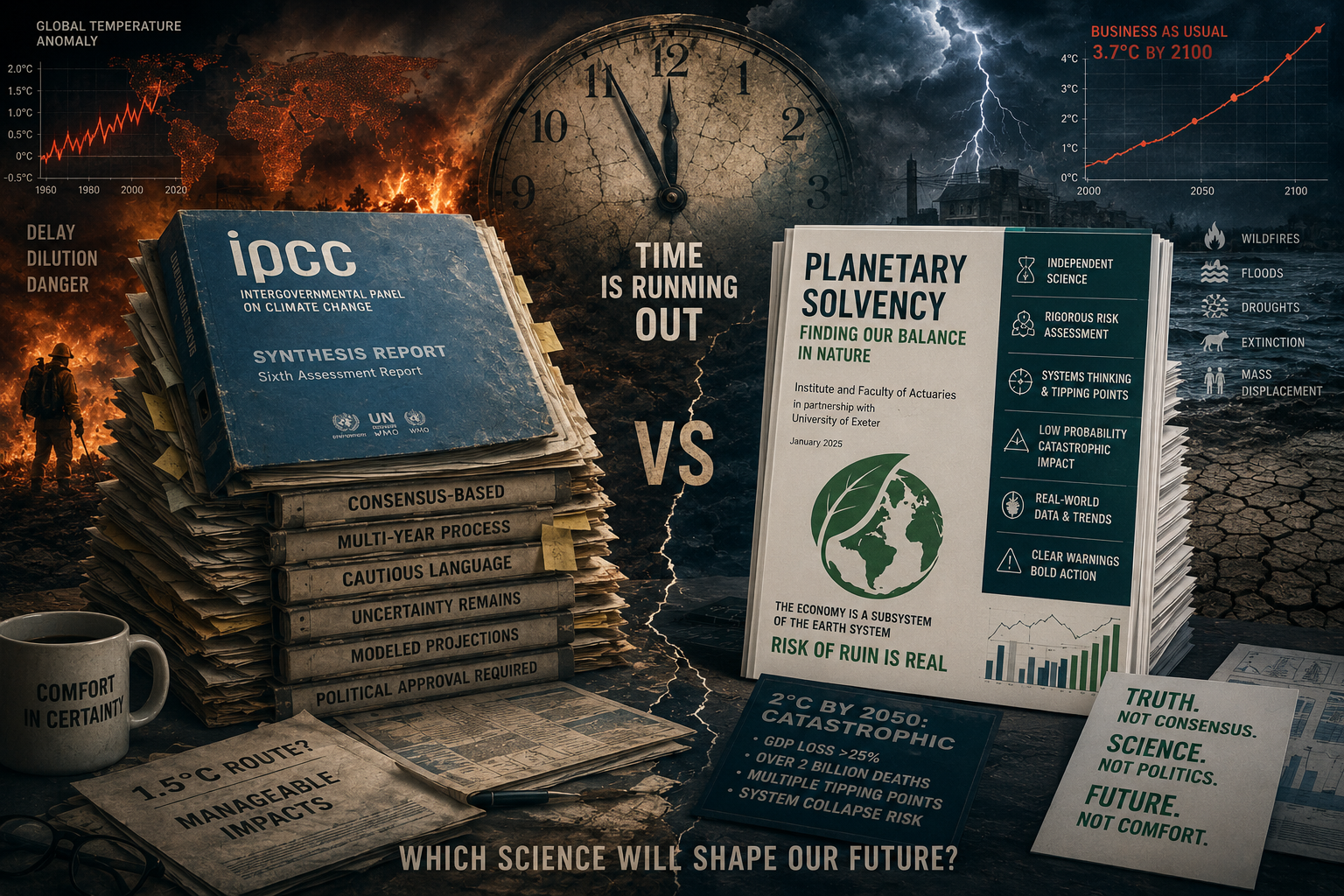
In January 2025, without any huge fanfare, the Institute of Faculty and Actuaries published its, “Planetary Solvency: Finding our Balance in Nature” Report, in partnership with scientists at the University of Exeter. It robustly critiques orthodox economic predictions which estimate that the impact of an average temperature increase of 3°C by the end of the century would be around 2% of annual GDP. “These estimates are precisely wrong, rather than being roughly right, and do not recognise there is a risk of ruin”. The Institute’s risk management experts diligently re-assessed risks associated with impacts such as fires, flooding, droughts, temperature increases and rising sea levels, through to 2050 and on to the end of the century.
There is now a very strong likelihood that we’ll experience an average temperature increase of at least 2°C by 2050 – an outcome described by the report’s authors as “catastrophic”. Take a deep breath and get your head around the projected impacts associated with that 2°C rise:
- Economic contraction; GDP loss of over 25%
- Mass human mortality events resulting in over 2 billion deaths
- Warming of 2°C or more triggering high number of climate tipping points
- Breakdown of some critical ecosystem services and earth systems
- Major extinction events in multiple geographies
- Ocean circulation severely impacted
- Severe socio-political fragmentation in many regions; low-lying regions lost
- Heat and water stress driving mass migration of billions
- Catastrophic mortality events from disease, malnutrition, thirst and conflict
Two billion prospective deaths by 2050. That’s just 25 years away. And for the final kicker, bearing in mind that we’re currently on a business-as-usual trajectory towards at least a 3.7°C temperature increase by 2100, the contraction in GDP then rises to 50% and the number of projected deaths rises to 4 billion.
The Institute’s definition of “Planetary Solvency” is fascinating:
“Planetary Solvency” assesses the ongoing ability of the Earth system to support our human society and economy. In the same way that a solvent pension scheme is one that continues to be able to provide pensions, a solvent Earth system is one that continues to provide the natural services we rely on, support ongoing prosperity, and a safe and just future”.
I’m not sure that the IPCC will welcome being called “precisely wrong rather than roughly right”, especially when it dives down into the details of this devastating critique. It basically stands accused of:
- Relying on excessively narrow, reductionist science, based on retrospective “proof-points”, without any capacity to cope with uncertainty and more sophisticated risk analysis;
- Failing to take into account the science of critical tipping points: “waiting for certainty” on whether these critical ecosystems will or won’t tip “risks ruin”;
- Slow-moving, static methodologies, which means that its risk assessments are infrequent and seemingly incapable of taking into account irrefutable evidence that the climate is changing far faster than its assessments indicate;
- Providing false (and therefore very dangerous) reassurance to governments that the scale of the damage done to the global economy by an average temperature increase of 2°C will be “manageable” at around 1.5% of global GDP. This is where the Institute accuses the IPCC of being “wholly wrong”.
In due course, I’m sure the IPCC will provide some kind of riposte. When it does, it will need to take into account another equally devastating report from scientists at The Institute for Climate Risk at the University of New South Wales, confirming the Actuaries’ hypothesis of underestimated financial risks – simply because the IPCC’s Integrated Assessment Models on which it has depended for decades are simply incapable of capturing major risks – what actuaries describe as risks with “low probability but catastrophic impact”.
So does some arcane stand-off between climate geeks and number-crunching actuaries have any relevance for the new Science Panel established by the Transitioning Away From Fossil Fuels Conference just a few weeks ago? It absolutely does! If the IPCC continues to provide governments with seriously flawed assessments of climate risk, furnishing them with every conceivable variety of comfort blanket that protects us from the “whole truth” about accelerating climate change, then there is literally no way governments will ever come up with timely, proportionate responses to the crisis.
We must hope that this Science Panel rapidly provides a new benchmark for genuinely independent and truth-telling science.
(For those interested in the work of the Institute and Faculty of Actuaries check out its latest report, “Planetary Solvency: Tipping Into The Wild Unknown”, co-authored with Anglia Ruskin University.
Jonathon Porritt 12 May 2025